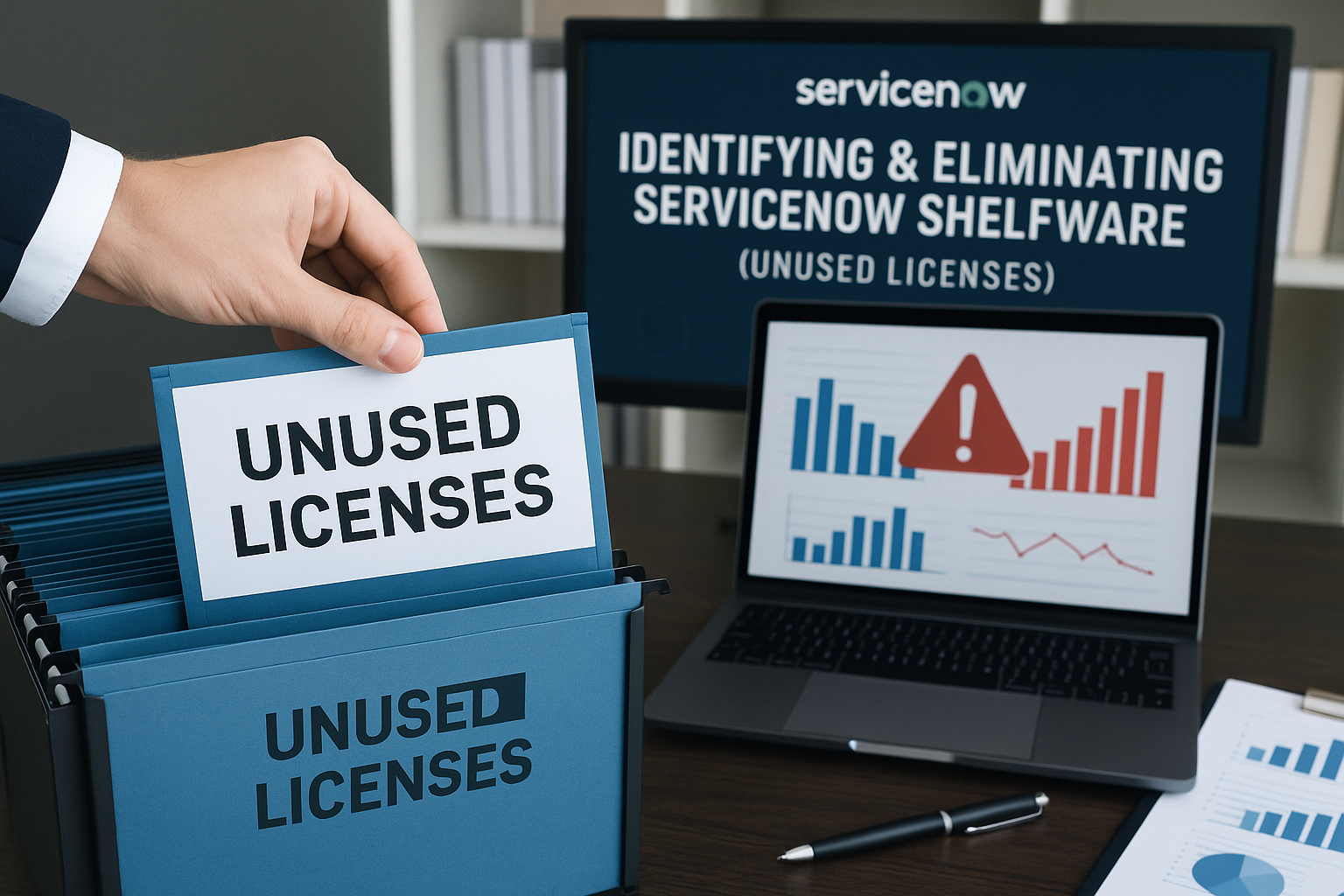
Is your organization paying for ServiceNow licenses that no one is actually using? If you suspect you have unused or underused ServiceNow licenses (a.k.a. shelfware), you’re not alone.
Many companies renew their ServiceNow contracts each year without realizing a chunk of their spend is for dormant users or modules. The good news is you can detect this waste, take action, and save big before your next renewal.
Let’s walk through a playbook on finding and eliminating ServiceNow shelfware.
Read our comprehensive guide, ServiceNow License Optimization: Rightsizing, Recycling & Shelfware Cuts.
What Is ServiceNow Shelfware (and Why It Costs So Much)
ServiceNow shelfware refers to paid licenses, roles, or modules in your ServiceNow environment that sit idle. In other words, you’re paying for capabilities that aren’t being utilized.
This might include user licenses assigned to people who never log in, premium roles given to folks who don’t need them, or whole modules purchased but barely deployed.
Why does shelfware happen so often with ServiceNow? A few reasons:
- Sprawling Platform: ServiceNow offers a ton of modules (ITSM, ITOM, HRSD, CSM, and more). It’s easy to buy more than you end up using, especially when modules are bundled or upsold during negotiations.
- Organization Changes: People leave or change roles, projects get delayed, and initiatives shift. But licenses often remain allocated out of habit.
- Auto-Renewal Mindset: ServiceNow contracts tend to auto-renew annually. Unless you proactively adjust your license counts, you keep paying for last year’s quota (including any shelfware) by default.
The financial impact of shelfware is real. In many enterprises, 15–30% of their ServiceNow spend is tied up in unused licenses. That’s the budget essentially thrown away on “ghost” users and idle features.
For example, in a Mini-Scenario, a construction firm discovered 400 inactive Fulfiller licenses during an audit. That was roughly $700,000 per year — gone with nothing to show for it. Imagine what else that money could fund if reclaimed!
Pro Tip: Shelfware isn’t a one-time mistake — it’s a recurring habit. If you don’t change how you manage licenses, you’re likely to repurchase the same unused capacity at renewal. Breaking the cycle now means immediate savings and a leaner baseline for the future.
Recycle licenses to keep costs low, Implementing a License Recycling Program in ServiceNow.
Where ServiceNow Shelfware Hides
Shelfware can lurk in various corners of your ServiceNow implementation. It often hides in plain sight, masquerading as “normal” license allocation until you dig into the data. Let’s uncover the usual suspects:
Unused User Licenses
One of the easiest places to find waste is in your user list. Over time, employees leave, contractors finish projects, or some staff simply stop logging into ServiceNow. Yet their accounts might still hold an active (and paid) license.
Start by looking at the last login data for all licensed users. Who hasn’t logged in within the last 60 or 90 days? Chances are, those users don’t need access anymore. Perhaps they left the company or moved to a role that doesn’t use ServiceNow. Many organizations forget to reclaim these licenses during offboarding or role changes, leading to a pile of unused accounts consuming licenses.
Also, cross-check if some active users have multiple accounts or duplicate roles, as this indicates potential license overlap. Every inactive or redundant user license is low-hanging fruit for cost savings once identified.
Pro Tip: Inactive doesn’t always mean unnecessary. Before you yank a license, confirm with team leads or managers that the user truly doesn’t need access. There could be cases where someone hasn’t logged in due to vacation, but their role still requires a license. Always double-check so you don’t accidentally remove something critical.
More insights on rightsizing, Rightsizing Your ServiceNow License Counts to Actual Need.
Overprovisioned Roles
Another common form of shelfware is giving out more powerful (and expensive) roles than needed. ServiceNow’s Fulfiller license is a prime example – it’s a full-access role intended for technicians and power users who work on tickets, configure items, or build workflows. Fulfiller seats are also among the priciest licenses. Meanwhile, Approver or Requester roles cost far less (or nothing, in the case of Requesters) but provide enough access for many users.
In practice, many organizations hand out Fulfiller licenses to users who rarely use those capabilities. Perhaps a department manager only needs to approve change requests or view dashboards – they could be an Approver (cheaper), yet they were given a Fulfiller license by default.
We often see scenarios where only about 1 in 5 people with a Fulfiller role actually open or resolve tickets every week. The rest are over-licensed, doing light usage that never justifies a full license.
Mini-Scenario: A bank’s IT team discovered that out of 800 Fulfiller licenses they were paying for, roughly 200 were assigned to managers and staff who only ever approved requests or ran an occasional report. By reassigning those 200 users to Approver roles, the bank saved about 25% of its ITSM licensing costs. The users continued doing their jobs (approving and viewing) without interruption – the only difference was a much lower bill.
The lesson: match roles to actual usage. Audit your Fulfiller roster and ask, “Does this person really need full platform rights, or could they function with a lighter role?” Often, you can downgrade licenses for occasional users and immediately cut waste.
Underused Modules
Shelfware isn’t just about users – it also hides in modules and add-ons that you’ve bought but aren’t fully leveraging. ServiceNow sells many modules in bundles or as part of its product suites, and it’s easy to end up with some that sit idle after purchase.
Common offenders include:
- HR Service Delivery (HRSD): Maybe it was rolled out to one region or department, while licenses were purchased for the whole company.
- ITOM Discovery or other IT Operations modules: Often bought early in a ServiceNow journey but never completely deployed due to project delays or complexities.
- ITSM Pro upgrades: Organizations might pay for the “Pro” (premium) version of IT Service Management to get AI or analytics features, but then not actually adopt those features (sticking to basic ITSM functionality instead).
If you suspect a module is underused, check its utilization metrics. ServiceNow’s dashboards or reports can show how often features in that module are being executed (e.g., number of HR cases opened, number of CSM tickets handled, etc.). If a module was purchased but you see barely a trickle of activity, that’s a red flag for shelfware.
Consider this quick data table of typical module shelfware scenarios:
| Module | Common Issue | Typical Shelfware % | Fix |
|---|---|---|---|
| HRSD | Partial rollout to one region | 40–60% | Drop excess seats |
| ITOM Discovery | Purchased early, not deployed | 30–50% | Suspend until rollout |
| ITSM Pro | AI/analytics features not adopted | 20–30% | Revert to ITSM Standard |
In each case, significant portions of the license count are effectively wasted on unused capacity. The “fix” might be reducing the license count at renewal, pausing the subscription until you’re ready to fully use it, or downgrading to a cheaper edition.
Orphaned Integrations
Sometimes shelfware hides in technical integrations or automated accounts. For example, you might have an API user or integration hub that was set up for a workflow you’ve since retired – yet the integration account still consumes a license or counts against usage metrics. Or perhaps you bought licenses for an integration-based module (like a Monitoring or Event Management integration) that isn’t actively sending/receiving data anymore.
It’s worth auditing your integration logs and any ServiceNow “service accounts” or integration users.
If certain connectors haven’t been active in months, you may be able to disable them and free up whatever license allotment they were tying up. Orphaned integrations can also skew your usage stats; cleaning them up gives a clearer picture of real user activity.
Checklist: Where to Look for Shelfware
- Inactive user accounts: Find users who haven’t logged in for 60+ days or ex-employees still holding licenses.
- Over-licensed roles: Identify any Fulfiller or admin roles assigned to users who only approve or view records.
- Underutilized modules: Review each licensed module for usage; flag those with minimal transactions or partially deployed.
- Integration accounts: Check if API users or integrations are still counted as active, even if their workflows have stopped.
Use this checklist as a starting point to hunt down shelfware in your environment. Now, let’s move on to how you can systematically identify these areas using data.
How to Identify Shelfware
Knowing where shelfware could be hiding is half the battle. The next step is to pull data and reports that clearly reveal the unused licenses. ServiceNow provides tools and analytics to help with this detective work.
Run a License Utilization Report
Begin with a high-level license utilization report. If you have ServiceNow’s subscription management module or a License Workbench, use it to export all current licenses and their usage. Key fields to capture:
- User ID / Name – Who has a license?
- Role/License Type – Fulfiller, Approver, etc., or which module license the user has.
- Last Login Date – When they last accessed the platform.
- Active/Inactive Status – Whether their account is active in the system.
By exporting this to a spreadsheet, you can calculate the percentage of active users versus total purchased for each category. For instance, if you have 500 Fulfiller licenses but only 350 users have logged in this quarter, that’s a clear sign of shelfware (150 licenses unused). Or if 200 HRSD licenses are allocated but only 50 HR cases are being opened per month, adoption is low relative to capacity.
Slice the data by department or module as well. You might find, say, the IT department uses 90% of its licenses, but HR uses only 50% of theirs – indicating an imbalance or an opportunity to trim the HRSD allotment.
Track Module-Level Adoption
Leverage ServiceNow’s Performance Analytics or built-in usage dashboards to dig into each module’s adoption. For every paid module or feature (ITSM, CSM, Asset Management, etc.), identify metrics that reflect usage:
- Number of records created (incidents, requests, changes, HR cases, etc.).
- Number of active users in that module.
- Transactions or jobs processed (for things like Discovery or orchestration tools).
Compare these metrics against what was expected when you purchased the module. If ITOM Discovery was supposed to scan 10,000 servers but you only ever configured 2,000, a large portion of that license is idle. If you bought a Customer Service Management (CSM) module for multiple product lines but only one small team is using it, that’s partial adoption.
A visual dashboard can help highlight modules with a flat line of activity (indicating shelfware) versus those with healthy usage. Bring these insights to your decision makers — it’s hard to argue for paying full price on a module that clearly isn’t being utilized.
Audit Role Assignments
Regularly auditing how roles are assigned in ServiceNow is one of the most actionable ways to spot license waste. You should periodically review all user roles, especially the expensive ones:
- Pull a report of all users with Fulfiller (or equivalent) roles.
- For each user, check their activity: How many tickets have they updated or resolved? How many workflow actions have they performed?
- Identify users who have powerful roles but show little to no hands-on activity.
In many cases, you’ll catch managers, team leads, or occasional users sitting with Fulfiller access that they rarely use. For those users, consider downgrading them to an Approver or even Requester role. They’ll still be able to do what their job actually requires (like approve tasks or submit requests), but you’ll save on license costs.
Pro Tip: If someone hasn’t touched a record in 90 days, they shouldn’t hold a premium license. Use 90 days of inactivity as a rule of thumb. It’s a strong indicator that the user can likely be downgraded or removed without impact. Just be sure to communicate changes in advance so there are no surprises.
Also, verify there are no generic or service accounts inadvertently holding a Fulfiller license. Sometimes, admins create a generic login for testing or training that ends up consuming a paid license—another easy win if found.
Eliminating Shelfware
Once you’ve identified where your ServiceNow shelfware is, it’s time to eliminate it. The goal is to either remove, reassign, or repurpose those unused licenses so you’re no longer paying for nothing. Treat this as a step-by-step optimization project:
Step 1 – Verify with Stakeholders
Before you start turning off licenses, have a quick validation round with relevant stakeholders or module owners. Share your findings with the people responsible for those users or modules:
- User licenses: Inform department heads or team leads that X users in their team haven’t logged in or appear over-licensed. Make sure those users truly don’t need access. (Maybe one is on long-term leave but coming back, etc.)
- Modules: Check with the product owner of a module if low usage means it’s not needed, or if there’s a planned ramp-up. For example, the HR director might confirm that HRSD was never fully rolled out beyond one region – so yes, those extra licenses can be dropped.
This step ensures you’re aligning license removal with business context. It avoids scenarios where IT unilaterally cuts something that, unbeknownst to them, a department was planning to use next quarter. Usually, stakeholders will appreciate the cost-saving initiative as long as you involve them.
Step 2 – Deactivate or Downgrade Unused Licenses
With confirmation in hand, proceed to actually remove the shelfware:
- Deactivate inactive users: For users who truly no longer need access, deactivate their accounts or remove their roles. This frees up those license entitlements. You can maintain a record of who was removed in case reactivation is needed later, but at least you’re not paying in the meantime.
- Downgrade where appropriate: Take those overprovisioned Fulfillers and switch them to Approver or Requester roles. This often can be done by adjusting group membership or roles in ServiceNow. Immediately, those expensive licenses go back into the pool and the users still have the access they require at a lower cost.
- Suspend underused modules: If a particular module subscription is largely shelfware, talk to your ServiceNow account rep about reducing the license count or even temporarily suspending that module in your contract. In some cases, you might remove it now and re-subscribe when you’re truly ready to deploy it fully.
Mini-Scenario: An energy company realized they had purchased a large block of HR Service Delivery licenses, anticipating a company-wide HR rollout. A year in, they had only rolled it out to one business unit – meaning most of those HRSD licenses were sitting idle. Instead of continuing to pay for the unused portion, they worked with ServiceNow to pause the unused HRSD licenses. They only reactivated (and paid for) them when the broader rollout resumed six months later. This move avoided roughly $300,000 in waste for that year.
Step 3 – Recycle and Reassign
Stopping the bleeding is great, but also consider eliminating shelfware as an ongoing practice. Put processes in place to recycle licenses continually:
- Whenever someone leaves the company or a ServiceNow-using role, have IT or the asset management team reclaim their license immediately. Don’t wait until the renewal true-up to account for it. That freed license could be given to the next new hire instead of buying a net-new license.
- Set up an internal license pool for expensive roles like Fulfillers. For example, if you know you usually only have 500 truly active Fulfillers at any time, but 550 in the contract, manage those 50 extra as a floating pool. When a new request for a Fulfiller access comes, see if you can assign from the pool (by removing from an inactive user) rather than increasing your license count.
- Integrate license management with HR onboarding/offboarding. Ideally, your user provisioning workflow should include a step to decide what kind of ServiceNow access a person needs (and reclaim any access when they depart).
By continuously recycling licenses, you prevent shelfware from accumulating again. It’s much easier to reassign an existing license than to justify an unnecessary budget for a new one.
Pro Tip: The fastest savings come from reclaiming before repurchasing. Whenever you have a new demand for a license, always check if there’s an unused license you can pull back from elsewhere. This habit can save you tens of thousands by using what you already have instead of blindly buying more.
Step 4 – Adjust the Renewal Baseline
After cleanup, it’s critical to update your renewal strategy. Don’t go into your next ServiceNow renewal with the old numbers as a baseline. Instead:
- Document the current actual usage post-shelfware removal. For example, now you might be actively using 300 ITSM Pro licenses instead of 400, or 100 HRSD instead of 250.
- When renewal discussions start, present this data clearly to your ServiceNow rep. Your goal is to reduce the committed volume (and cost) to match what you really use. If you removed an entire module, plan to strike it from the contract or swap it for something more useful.
- Use shelfware elimination as leverage. Showing that you’ve identified unused licenses sends a message: you’re an informed customer who won’t pay for excess. ServiceNow sales teams are often willing to negotiate terms rather than lose that portion of the business entirely.
Suppose you still need a similar number of licenses but your usage efficiency has improved. In that case, you can leverage that too – perhaps negotiate a better price per license or additional value elsewhere, since you’ve proven you’re not afraid to trim fat.
Pro Tip: Shelfware discovered before renewal becomes negotiation leverage — after renewal, it’s just a sunk cost. In other words, you have the most power to optimize and save before you sign the next contract. After you sign, any shelfware is money spent that you can’t get back for that term. So make the pre-renewal true-up count.
By adjusting your renewal baseline, you lock in the savings year over year and avoid the “accordion effect” of shelfware creeping back in when new budgets get approved.
Preventing Shelfware from Coming Back
Now that you’ve cleaned up a lot of the waste, the final piece is keeping it from accumulating again. Shelfware is fundamentally a governance issue – it grows when there’s a lack of monitoring and license discipline. Here’s how to keep your ServiceNow usage optimized going forward:
Monitor Quarterly
Treat license usage as a key metric to review regularly. Don’t wait for the annual renewal crunch to check who’s using what. A quarterly audit of ServiceNow usage can be a simple practice:
- Run the same user activity reports and module usage stats every quarter.
- Trend the data: Are there certain teams where usage is dropping? Any new software emerging because a project ended?
- Include a summary in IT or asset management governance meetings. Keeping leadership aware of license utilization rates (e.g., “we’re at 90% utilization for Module X, but only 50% for Module Y”) helps maintain focus.
By catching underuse early, you can course-correct mid-year (maybe reallocate licenses, or plan a user training to boost adoption, etc.) rather than discovering a huge pile of waste later.
Assign License Ownership
One effective tactic is to designate license owners or stewards for different parts of the organization or for each major module. This could be a person in each department responsible for that department’s ServiceNow access, or a product owner for each module.
Their job is to regularly review who in their area has licenses and whether they still need them. They can be given a quarterly usage report specific to their team/module. Because they know the business context (who’s left, who’s inactive, what projects are on/off), they can quickly flag adjustments.
For example, the HRSD module owner might know that a certain region’s rollout was put on hold, allowing them to proactively release those licenses or reduce usage. When someone “owns” the licenses, it creates accountability to not let shelfware fester.
Automate Alerts
Leverage automation in ServiceNow to help catch potential shelfware without manual effort:
- Set up an alert for user inactivity: for example, if a user with a paid role hasn’t logged in for 60 days, trigger a notification to the license manager or that user’s manager to ask if the access is still needed.
- Use workflows to revoke or downgrade roles automatically after a period of inactivity. For instance, after 90 days of no activity, a script could move a user from Fulfiller to inactive (pending approval).
- Create dashboard widgets that highlight underused licenses or modules. A simple indicator like “Licenses in use vs purchased” for each product can visually signal if something drops below, say, 70% utilization.
Automation ensures that even if your team gets busy, obvious shelfware signals don’t get overlooked. It turns license optimization into a continuous process rather than an annual fire drill.
Embed Optimization in Procurement
Finally, bake shelfware prevention into your procurement and renewal processes:
- Pre-renewal checks: Make it a policy that X months before any software renewal (not just ServiceNow, but especially ServiceNow due to its cost), a usage review must be done. Tie this requirement to the approval process for the renewal budget.
- Justify new requests: When a team asks for additional ServiceNow licenses or a new module, have them provide a simple utilization plan or check against current usage. If another team has spare licenses, perhaps the request can be filled by reallocating instead of buying more.
- Cross-functional reviews: Bring together IT, finance, and procurement to review license usage reports. This ensures everyone knows the state of play and can align on not buying shelfware. It also signals to the organization that software spend is scrutinized for value.
By making these practices standard, you create a culture where shelfware is noticed and weeded out before it grows.
Read about our ServiceNow Optimization Services.