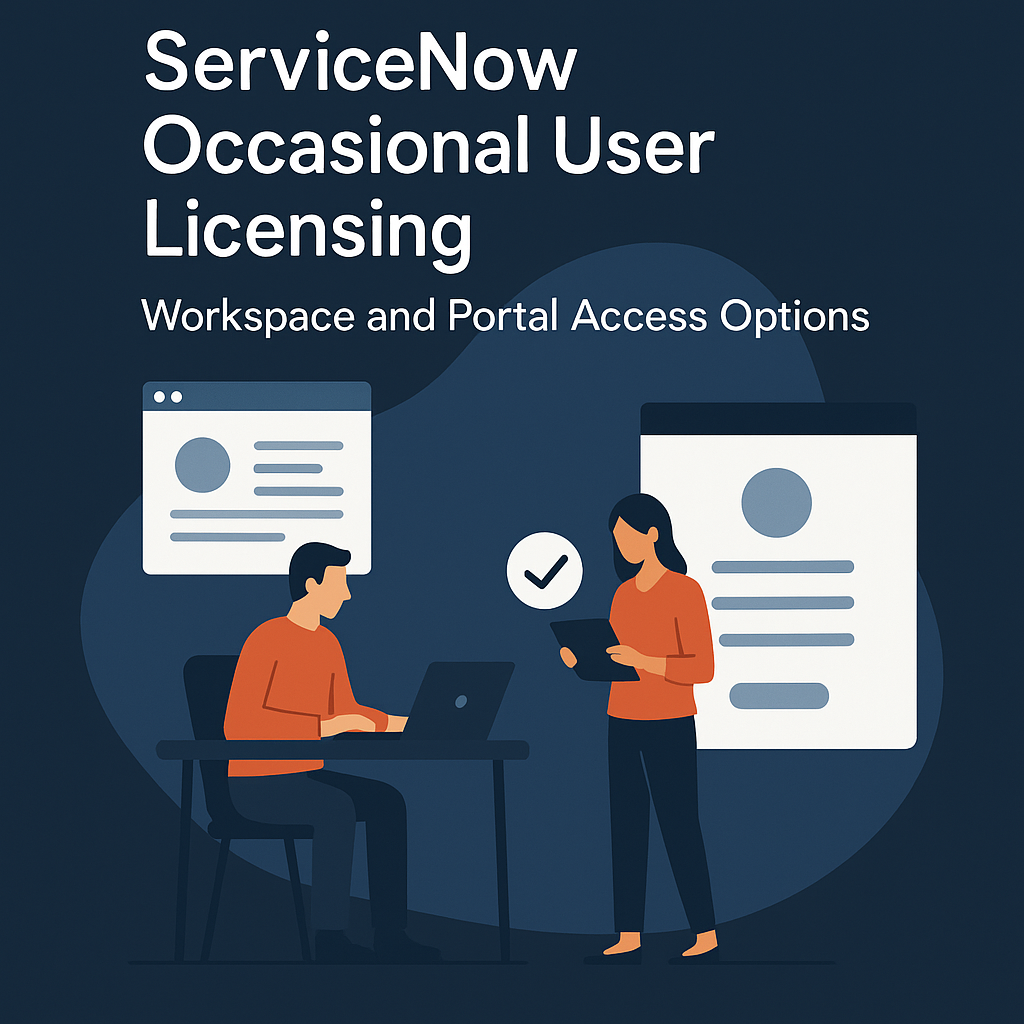
ServiceNow Occasional User Licensing – How to Extend Access Without Overspending
Not everyone who touches ServiceNow needs a costly full-access license. ServiceNow’s occasional user licensing is all about providing the right level of access to infrequent users, allowing you to include more people on the platform without blowing your budget.
Many organizations overspend by giving a full Fulfiller license to employees who only log in occasionally to approve a request or check a status. The key is to extend ServiceNow’s reach cost-effectively by using low-cost or no-cost access options for these light users.
In this guide, we’ll explain practical ways to do just that – from leveraging the free Service Portal for requesters to assigning limited roles like Approver or Stakeholder, and even managing part-time agent access via Agent Workspace.
The goal is to help you expand platform participation without overspending, all while staying compliant with ServiceNow’s licensing rules.
Read our comprehensive guide, ServiceNow Named User vs Role-Based Licensing – Understanding Subscription Models and Access Options.
Who Are Occasional Users?
“Occasional users” are those employees who use ServiceNow infrequently rather than as part of their daily job. Think of department managers who only log in to approve change requests, or employees outside IT who raise a ticket once in a blue moon.
These users aren’t performing technical work on the platform – they’re not resolving incidents or configuring workflows. Instead, they need light-touch access such as visibility into requests, the ability to submit or approve items, or to check the status of work.
In many companies, a significant chunk of licensed users fall into this category. For example, a manufacturing firm licensed 300 full users, but 80% of them only logged in once a month for approvals.
In this case, the majority were occasional users paying for expensive licenses they hardly utilized. Occasional users typically don’t require the full toolset a ServiceNow Fulfiller enjoys. If someone isn’t actively resolving tickets or updating records every day, they’re likely a light user who could be on a much cheaper (or free) role. Identifying these users is the first step – once you know who they are, you can find more economical ways to keep them involved in the platform.
Tips on how to maximize named licenses: Maximize ServiceNow Named Licenses – Getting Full Value from Every User Seat.
The Free Option – Service Portal Access for Requesters
One of the best ways to include everyone in ServiceNow at no cost is through the Service Portal. The Service Portal is a user-friendly web interface where any employee (or customer) can submit tickets, make requests, and track the status of their issues.
The great news is that portal users cost nothing – these “Requesters” do not need a paid license at all. ServiceNow allows unlimited requesters for free, meaning every employee can have basic access to create and view their own requests without incurring licensing fees. This is ideal for occasional users whose main interaction is asking for help or information.
Even without a license, Requester users can log into a ServiceNow portal or Employee Self-Service site to open incidents, request services, read knowledge base articles, and see updates on their tickets. You can also customize the portal’s forms and workflows to capture all necessary details from requesters, tailoring the experience to your organization’s needs.
Importantly, doing so doesn’t change any licensing requirements – no matter how many form fields or custom offerings you have on the portal, requester access remains free. The only actions these users cannot perform are editing records beyond their own, approving tasks for others, or performing any backend work – but those functions are typically not needed by casual users anyway.
Checklist: Ensuring you maximize the Service Portal for occasional users:
- All employees can use the Service Portal with a free Requester login, enabling broad self-service.
- Customize request forms and workflows as needed without changing license scope or costs.
- Restrict any edit, approval, or fulfillment rights to your licensed IT staff – portal users should only submit and view their own items.
Pro Tip: Every employee should use the Service Portal — it’s unlimited, free, and built for scalability. Make self-service the default for any user who just needs to ask for support or information, instead of giving them a paid account.
The Low-Cost Option – Approvers and Stakeholder Roles
What about users who need more than a requester but far less than a full IT agent? This is where Approver or Business Stakeholder roles come in.
An Approver (often labeled as a Stakeholder in ServiceNow licensing) is a limited user license meant for managers, department heads, and other stakeholders who must log in to view records, approve or reject requests, and maybe add comments, but who do not fulfill tickets or perform configuration. In other words, they have more privileges than a basic requester – they can see relevant data and participate in workflows – but they aren’t doing hands-on IT service work.
From a licensing standpoint, these roles are much cheaper than Fulfiller licenses and sometimes even bundled at no extra charge, depending on your ServiceNow agreement.
In many modern ServiceNow contracts, you might get a certain number of stakeholder users included, or you can purchase a block of them at a fraction of the cost of the same number of fulfillers. The exact terms vary, but the principle remains: don’t put an occasional approver on a full license when an approver/stakeholder role will cover 90% of their needs at a fraction of the cost.
Organizations often discover huge savings by reclassifying light users into the stakeholder tier. For instance, a global bank realized hundreds of managers were set up as full ITSM fulfillers even though they only ever clicked “Approve” on change requests. By reclassifying 400 of these infrequent users to Stakeholder roles, the company cut approximately $350K in annual licensing costs. Those users still had the visibility and approval ability they required, and nothing in their daily work was lost – except the unnecessary license fees.
Pro Tip: Stakeholder roles deliver nearly all the functionality an approver needs — at close to 0% of the cost of a full license. Always use the lighter Approver license for any user whose main ServiceNow activity is reviewing or approving items, rather than defaulting them to a Fulfiller out of habit.
Read how to choose a subscription model, ServiceNow Subscription Model Selection – Balancing Flexibility and Cost.
Using Agent Workspace for Occasional Access
ServiceNow’s Agent Workspace is a modern interface that provides a consolidated view for support agents to handle their tasks efficiently. The good news for license managers is that Agent Workspace access doesn’t require a separate license – it’s a feature included with the platform for users who already have the appropriate roles.
In practice, this means if someone is assigned a Fulfiller or similar role that permits working on tickets, they can use the Agent Workspace UI without any additional fee. There is no such thing as a “Workspace license” to buy; it’s simply an alternative interface for doing ITIL or customer service work.
For occasional support agents or backup staff, this is useful. You might have some employees who step into a support role only during peak periods or as a secondary duty. They can be given the necessary role (for example, an ITIL role for ITSM) to log into Agent Workspace when needed, and since they’re covered under your existing license count, you won’t pay extra for the workspace itself.
However, be mindful of compliance: the right to use Agent Workspace comes from the user’s role, which in turn ties to a license. You cannot bypass licensing by simply having someone use the workspace occasionally – if they have a fulfiller role, they count as a license whether they use the classic interface or the workspace.
One strategy is to manage these occasional agents within your named license pool through role governance. For instance, you might have 50 fulfiller licenses but 60 people who sometimes need fulfiller access. With careful coordination, you could assign and unassign roles so that no more than 50 are active at a given time. This way, your “floating” support members can still log in during their rotation without exceeding your license count.
Always document and enforce such processes to stay compliant – sharing one login among multiple people or any unapproved concurrency is against the rules. The bottom line is that Agent Workspace is an included feature to enhance user experience, but the license cost is determined by the role you assign, not the interface they use.
Don’t assume you can scale up the number of agents freely just because Workspace is available; ensure those occasional agents are accounted for under your licensing model.
Avoiding Over-Licensing for Light Users
A common source of waste in ServiceNow licensing is over-licensing light users. It often happens out of convenience – perhaps during initial setup, everyone got a fuller role, or maybe managers insisted on full access “just in case.”
The result is many users holding expensive licenses that far exceed their actual usage. To avoid this, organizations should adopt a tiered licensing strategy aligned to real user activity:
- Fulfiller licenses for daily power users: These are your IT staff and others who truly work in ServiceNow every day, updating tickets, building workflows,and running reports. They need full functionality, so keep these licenses for the people in the trenches.
- Approver (Stakeholder) licenses for managers and occasional participants: People who oversee processes, approve tasks, or need read access fall into this category. They interact regularly but not in a hands-on way. Use the mid-tier license for them and avoid giving them edit rights that unnecessarily bump them to a higher tier.
- Requester access for everyone else: For the vast majority of employees who just raise requests or check statuses occasionally, the free Service Portal role is sufficient. Make sure these users know how to use the portal or mobile app for self-service, and they shouldn’t have any paid roles at all.
Regular governance is crucial to maintain this balance. Start by reviewing how often each named user actually logs in and what they do. If you find someone with a full license who logs only a handful of activities per month, it’s a flag to downgrade them.
Consider running usage reports quarterly to catch changes – people’s roles evolve, and license allocations should too. IT Asset Management (ITAM) teams can help implement a routine process: for example, any user with fewer than five logins or updates in the last 90 days might be moved down to an approver or requester role (after confirming with their manager).
Likewise, if someone’s responsibilities grow (say, a department analyst now regularly updates records), you can upgrade them to fulfiller as needed. The goal is dynamic right-sizing of licenses rather than a set-and-forget approach.
Checklist: Steps to prevent over-licensing of light users:
- Review login frequency and activity metrics for all users (at least every quarter).
- Reassign or downgrade roles for users who aren’t utilizing the capabilities of their current license tier.
- Map each user’s ServiceNow access level to their actual task needs – license by what they do, not by their job title or seniority.
Mini-Scenario: An energy company took a hard look at its ServiceNow usage data and realized many managers with fulfiller licenses barely touched the platform. They executed a license cleanup, reducing their fulfiller count by 25% and moving those users to Approver or Requester roles.
The result? No impact on productivity or workflows – those users continued approving and monitoring as before – but the company saved a substantial sum at the next renewal by not paying for unused high-tier licenses.
Pro Tip: License by activity, not title. It’s the simplest rule for avoiding waste. Don’t assume a vice president needs a full license if they never work tickets; base license assignments on actual platform usage and responsibilities.
Licensing Occasional IT Agents – Flexibility Through Role Governance
Sometimes, even IT staff can be occasional users. Think of part-time agents, contractors, or seasonal support staff who only need to use ServiceNow during certain periods or for backup coverage.
Licensing these users can be tricky – you don’t want to buy a full annual license for someone who might only be active for a few weeks or months. To address this, companies should implement flexible role governance and negotiate contract terms that accommodate these patterns.
Operationally, one approach is to create dedicated accounts or roles that you activate and deactivate as needed. For example, you might have a pool of 10 extra “agent” accounts that remain unassigned or inactive until a busy season hits (like a retailer ramping up help desk support during the holidays).
When the time comes, you can activate those accounts for temporary staff and deactivate them afterward. The key here is tracking and compliance: under a standard named-user model, you can reassign a license to a different user only after you’ve removed it from the original user. There’s typically no additional cost to reassign, but you must ensure you’re not concurrently exceeding your purchased license count at any given time.
Good governance means having a clear process to rotate these licenses among users and keeping records in case of an audit to show you never exceeded the limit simultaneously.
Beyond internal processes, leverage your contract negotiations to build in more flexibility for occasional agents. ServiceNow is often open to custom terms for large customers.
For instance, you might negotiate a 10% “floating” license buffer that allows you to exceed your named license count by up to 10% for a short period without penalty.
Alternatively, negotiate the right to temporarily expand and then reduce licenses mid-term (sometimes called elastic or temporary licenses). In one case, a retailer secured a contractual clause for a seasonal surge: they could activate an extra 50 support accounts for up to 3 months per year at no additional charge, as long as those were deactivated afterward. This kind of arrangement avoided the need to permanently purchase more licenses just to handle peak season workload.
Always get any flexibility in writing – don’t rely on verbal assurances. If your agreement allows for reallocating licenses or includes a floating pool, ensure everyone on your team understands and follows the limits. And if it doesn’t, plan for renewals to introduce these ideas. It’s far cheaper to have a temporary license mechanism or a swap option than to pay for year-round licenses for occasional staff.
Pro Tip: Temporary license reassignments or floating pools are much more cost-effective than permanent expansions – but they must be explicitly allowed in your ServiceNow contract.
When negotiating, push for provisions that let you accommodate part-time and seasonal users without breaching compliance.
Managing Cost Visibility with Dashboards
You can’t optimize what you don’t measure. To keep occasional user licensing under control, organizations should maintain clear visibility into how licenses are being used. ServiceNow provides tools like subscription management dashboards and usage analytics, and you can also build custom reports to track key metrics.
By using dashboards, SAM/ITAM managers can quickly see how many users are active, how often each person logs in, and which roles are being utilized or underutilized.
Set up utilization thresholds to flag potential waste. For example, you might create a report that lists all Fulfiller license holders with fewer than 10 activities or logins in the past quarter. Each name on that list is a conversation: Do they really need that license, or can they be shifted to a lighter role?
Similarly, monitor Approver role usage – while cheaper, even those shouldn’t be handed out like candy if not needed. Some organizations integrate these dashboards into their regular IT governance meetings, ensuring that license usage is reviewed alongside other performance metrics.
Another angle is cost reporting. Translate usage data into financial terms to make the impact clear to stakeholders. A dashboard could estimate the cost of inactive licenses (e.g., “$X potentially wasted on 20 underused Fulfiller licenses”).
Having this evidence makes it easier to take action (internally to reassign licenses) and strengthens your position when negotiating with the vendor. You can confidently discuss reducing license counts or adjusting mixes when you have hard data showing actual usage patterns.
Pro Tip: Usage data turns gut feel into evidence. Don’t rely on assumptions about who uses ServiceNow – build real reports and dashboards. Before every renewal or true-up, review these insights to drive your strategy. This data-driven approach ensures you pay for what’s actually needed and nothing more.
5 Insightful Next Steps for Buyers
- Identify all users with minimal activity: Run a usage report to find every employee with fewer than 10 ServiceNow logins (or ticket updates) per quarter. These are your prime candidates for reclassification as occasional users.
- Reclassify light users to lower roles: Take that list and proactively convert those people to Requesters or Approvers as appropriate. If they’re not actively resolving tickets, they shouldn’t occupy a costly Fulfiller seat. Communicate the change and ensure it won’t hinder their duties (in most cases, it won’t).
- Ensure full coverage via the Service Portal: Double-check that every employee in your organization knows how to access and use it for their IT and service needs. The portal should be configured to handle all common requests so that no regular employee ever needs a full license just to get help.
- Negotiate flexibility for seasonal staff: If your workforce includes temporary or peak-season ServiceNow users, plan for how to license them. Talk to your ServiceNow rep about floating license options or the ability to swap users in your license pool. Get agreements in place now for mid-term adjustments, so you’re not forced to overbuy.
- Review Agent Workspace usage for role bloat: As you deploy new interfaces like Agent Workspace or mobile apps, audit who gains access. Make sure you haven’t accidentally given someone a higher role so that they can try a new feature. Keep an eye on roles to prevent “role inflation,” and use the workspace as a tool for existing licensed users rather than a reason to add more fulfillers.
By following these steps, buyers and license managers can extend ServiceNow access to all who need it – on the right terms. Occasional users can be included in the ServiceNow ecosystem without each one carrying a hefty price tag.
It’s all about aligning each person’s level of access with their actual needs, and leveraging the platform’s flexible options (like portals and stakeholder roles) to maximize value for every license dollar spent. With careful planning and ongoing oversight, you can support broad ServiceNow adoption in your organization while keeping compliance in check and costs under control.
Read about ServiceNow Advisory Services.